


Indonesian consumers were shaken last year after government spot-checks revealed that multiple confectionery products being sold on shelves contained pork, despite all such products already being subject to the country’s mandatory halal certification law since October 2024.
In a move to better clarify and standardise the implications of improper food labelling, the local Halal Product Assurance Organising Agency (BPJPH) is now moving to introduce a new set of draft regulations specifically for non-halal (also known as haram) food labels.
These were notified to the World Trade Organisation in February 2026.
“All non-halal products must carry a Non-Halal Statement in the form of an image or clear wording – said image would be a picture of a pig which will clearly indicate the product’s haram content,” BPJPH Head Ahmad Haikal Hasan said via a formal statement.
“This information must be clearly displayed on the product’s primary and secondary packaging, or specified locations on the product itself. Placement must be in the most easily visible and readable area, and any use of background images, colours or designs must not obscure this information.”
The pig image is important for food companies selling foods and beverages containing pork in Indonesia. BPJPH has mandated the Non-Halal Statement to include red text stating ‘Contains Pork’ as well as a picture of a pig, both to be included in a red rectangular box on white background. Text alone will not be sufficient for products in this category.
For non-halal products that do not contain pork, a text label will be sufficient.
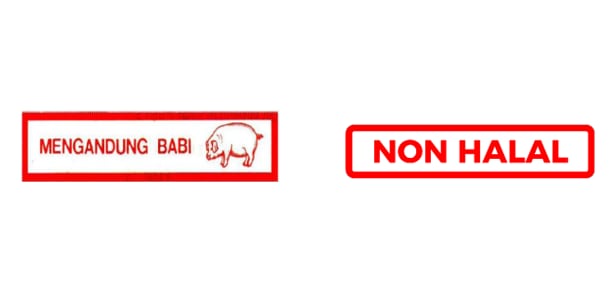
“Products which are in red packaging can use a different text and background colour as long as the contrast is sufficient for easy reading,” he added.
Strict warnings have also been issued for text and background colour to ensure contrast and readability, and it has even been specified that the label ‘must not be easily erased, removed, or damaged’.
Indonesia’s WTO notification is currently still available for public viewing on the WTO notifications portal here, and the full draft regulations document can be found here. It is still open for public comment, and comments can be sent to Indonesia’s National Standardisation Agency (BSN) here until March 14 2026.
Non-halal products
Indonesia has been exceptionally careful to highlight the criteria of all ingredient sources considered non-halal or haram in these draft regulations.
Commonly-known haram animal sources such as pigs and dogs are classified as unclean (mughallazhah), but there are other less-considered animals such as predatory animals (eg. Tigers, monkeys, crocodiles), reptiles (snakes, lizards), and insects other than grasshoppers and cochineal.
These may not be common food or ingredient sources, but the advent of alternative protein technologies has made these specifications necessary. These include the insect protein sector where black soldier flies and crickets are common ingredients, and even cultivated meat where Australia’s Vow has cited plans to deliver exotic meats such as lion and tortoise in the future.
Similarly, there are also major implications here for companies using microbial-derived or genetically engineered ingredients, as it has now been specified that all microorganisms and genes involved must not have had any contact with pigs, even with regard to external factors such as growth media.


