


Beer is not usually equated with healthier beverages or functional innovation, but with the health and wellness trend firmly afoot among consumers, many brewers are moving to develop options in line with this trend.
Craft brewers in particular have embraced this trend of functional beers, with many usually starting off by removing ‘unhealthy’ components such as carbohydrates or alcohol.
“It is much easier for craft breweries to work on developing functional beers as we can access the necessary ingredients and make tweaks to the recipes much more quickly than mainstream breweries,” Thailand-based Full Moon Breweries Founding Partner and Head Brewer Sukij Thipatima told us.
“There is also no reason to think beers can’t be tasty and refreshing when they are functional – our SayPlay Cold IPA low-carb beer has been the best-selling craft beer in Thailand for the past two years.”
Even more impressively, SayPlay emerged on top of the craft beer list despite not having highlighted low-carb as a feature, due to local regulations in Thailand.
“SayPlay is actually considered ultra low-carb as it contain just 2.5g of carbs per serving compared with the regular 12g to 15g – we do not focus on this due to of Thai alcohol marketing regulations, but it made its way to the top anyway,” he said.
“It is the first representative in our functional beer platform, and we consider this to be a very important development in the craft beer sector because it enables us to recruit more new drinkers into the category, both new craft beer drinkers as well as more health-conscious drinkers.”
Probiotic beer
Apart from the lowering of alcohol and carbohydrates, functional innovation in beer has also taken a turn towards gut health with the development of beer containing probiotics.

The technology for this was first developed by researchers in the National University of Singapore (NUS), leading to the launch of NUS start-up Probicient’s Red Billion Probiotic Raspberry Sour Beer, a 4.5% ABV brew with one billion Lactobacillus paracasei L26 CFUs per serving.
Another Singapore firm, Zesty Gut also recently picked up the patented technology to launch its new ‘Belgian-style probiotic wheat beer’ under the OMG (Oh My Guts!) branding, which has a 4.2% ABV and less than 100 calories per 330ml bottle.
“[The focus is on getting] all the flavour and refreshment of a classic beer, but with added benefits that promote digestion and gut health,” Zesty Gut marketing manager Ann Nguyen said.
“This beer’s one billion probiotic CFUs can help maintain a healthy gut microbiota for effective digestion and nutrient absorption, reducing negative post-drinking effects such as bloating.”
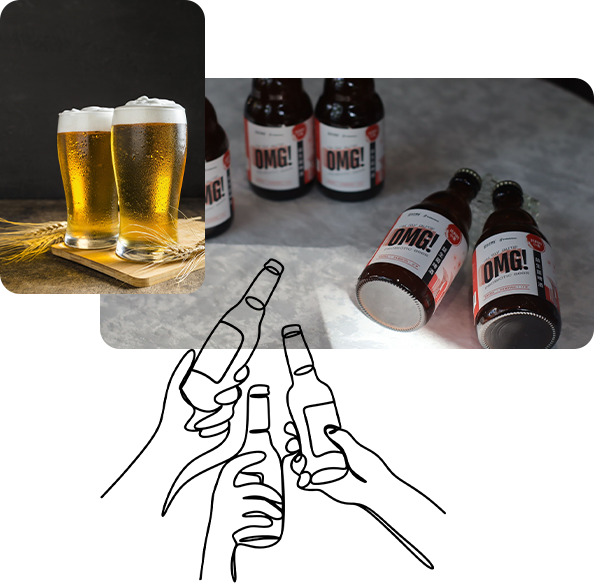
This product also contains antioxidative phenolic compounds, as well as amino acids and metabolites produced during the fermentation process which are associated with various health benefits.
Beer for mood modulation
Apart from gut health, functional beers can potential also contribute to improving mood – and not in the conventional way that involves any intoxication.
UK-based Collider has created a range of mood-boosting, non-alcoholic beers that tap a proprietary blend of adaptogens for its effects.

“Our proprietary mood-boosting Unwind Blend of functional mushrooms and active botanicals delivers a euphoric calm without the need for alcohol,” Collider Founder Harry Cooke said.
“The beer is brewed the same way you would brew an alcoholic beer, with special yeast strains and temperature control, and special processes remove the gluten from any wheat and barley used without adversely impacting the flavour.”
Collider comes as a lager or Session IPA, both containing no more than 0.5% ABV per 330ml can, and some of the major functional ingredients include the adaptogens lion’s mane mushroom, L-theanine and ashwagandha.
Lion’s mane mushrooms aid with reducing stress levels, ashwagandha stress hormones and promotes production of the calming hormone GABA, whereas L-theaninepromotes production of the ‘happy hormone’ serotonin and reduces stress hormone levels.
Much more potential to explore
Given the wide scope of potential functional innovations that could potentially link beer with health benefits, there is a large playing ground out there for craft breweries as well as food technology companies to look into.
Full Moon for one already has major plans to expand its functional range.
“The craft beer business is in itself very challenging, and doubling down on our functional platform means this will be even more challenging, but we believe that this is the way to go,” Thipatima added.
“What has worked for us so far has been to establish a strong commercial foundation and capture the right commercial channels, and we will continue to expand on this for functional beer.”
The brewery recently launched a non-alcoholic beer under the SayPlay brand as well, dubbed the SayPlay Nano IPA and containing less than 0.5% ABV.

“The biggest appreciators of these functional beers are Gen Zs, and even though we don’t highlight the functional characteristics, they know to read the labels and find what they want,” he said.
“We are also exporting SayPlay to other APAC markets including Taiwan, Japan, Australia, New Zealand, Cambodia, and Hong Kong; as well as to Russia.”
Zesty Gut also plans to continue its forays into functional beer innovation.
“Since we can add probiotics into beer, it opens up room to incorporate other functional ingredients,” Nguyen said.


